Chicago Has a Very Specific Idea of Who Counts as a Victim (The Five for 06/23/26)
Plus, your "Product of USA" sticker is lying, and Ethiopia is sliding toward war.

Hey, welcome to The Five, a publication about the stories that matter, but don’t always make the front page.
If you've never shared this publication with anyone…I'm asking if you might send this one along to a friend…in particular, the stories about the American beef industry, and the situation in Ethiopia, are two stories that I think need more attention, and the mainstream press is just ignoring.
With that being said, let’s get into the news.
[one]
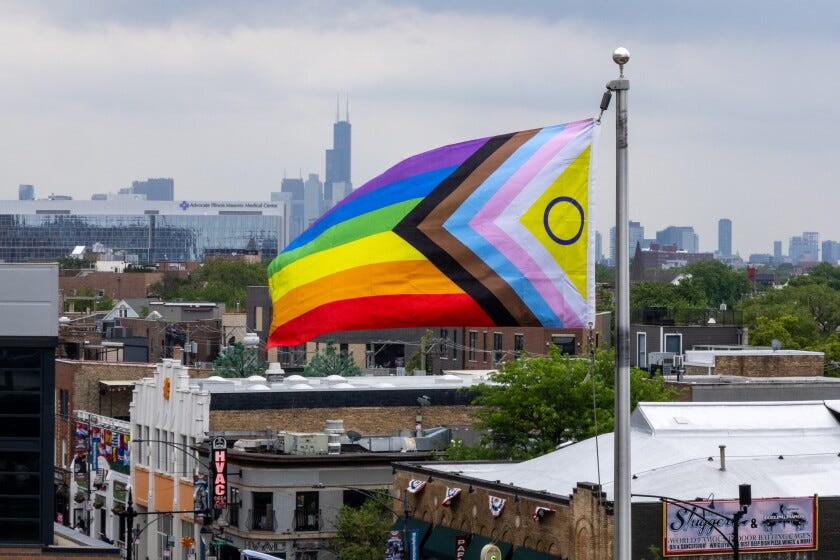
The city of Chicago has a rather skewed idea of what a “victim” is.
From the Chicago Sun-Times:
A mayoral working group focused on anti-trans violence released its first report Tuesday, with recommendations for city agencies to create a “long-term strategy” to remove structural barriers for trans people.
The report outlined policy changes on a wide range of issues: housing, inclusive workplace practices, health care access, community organization partnerships and collecting more data, such as metrics on how many trans people the city employs.
Mayor Brandon Johnson created the group in December 2024 to review city policies and training related to hate crimes and violence against trans women of color.
The report hasn’t made its way to city agencies yet, so specific policies are sparse. A June 30 Chicago Health and Human Relations committee meeting will introduce it to City Council.
But Kenneth Gunn, head of the mayor’s Commission on Human Relations, said immediate action can be taken while city agencies discuss how to implement the recommendations. Improving advertisement of existing city services for trans residents is “low hanging fruit.”
The city health department is already compiling a list of local gender-affirming health care providers, though CDC funding rules sometimes “constrain action.”
Creating non-police alternatives for reporting hate crimes and making city workplaces more inclusive were among other suggestions. The group cited the case of CTA worker Ava Hudson, who died by suicide Aug. 7, 2024.
“People have to feel safe and supported in the workplace, that’s something I would’ve liked to see happen yesterday,” Gunn said. “Where else are these kinds of things happening… It was a wake up call for all of us.”
Some solutions “won’t be made overnight,” Gunn said.
The report recommended CPS partner with other city agencies to provide better access to mental health resources and health care for trans youth, citing Sun-Times reporting on rising trans teen suicides in Illinois.
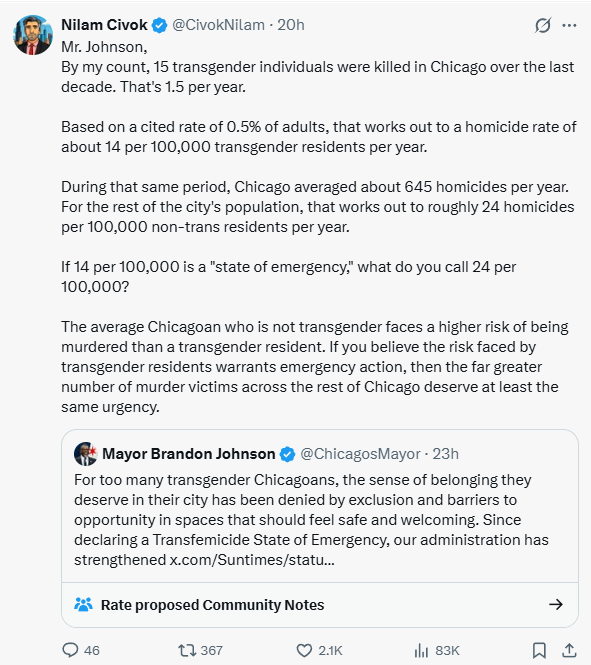
This all sounds alarming, until you dig into the data. By the city’s own per-capita logic, the average Chicagoan is at higher risk of being murdered than a trans resident. If 14 per 100,000 is a “state of emergency,” what’s 24?
To be specific, there were nearly 40 people shot, 8 of whom died over the Juneteenth/Father’s Day weekend in Chicago. Unless something wasn’t reported, none of them were trans. The victims were almost certainly poor people stuck in bad neighborhoods, if the typical pattern holds.
But won’t worry, Mayor Johnson knows who’s REALLY at fault. Richard Nixon. A bit of perspective, the former POTUS died of a stroke in 1994, which was three years before the invention of AOL Instant Messenger. In fact, when the 37th POTUS left this world, only 4.9% of Americans had home internet. Just 24% owned a personal computer.
But yeah, tell me about it Mayor Johnson.
NOTE: This clip is from 2024, and it comes from a longer answer that’s really about the war on poverty and the politics that buried it. So yes, it’s cut to make Mayor Johnson look worse than the full thing does. But the core issue survives the edit. Brandon Johnson holds the reins. The police, the budget, the whole city payroll report to him. And when Chicago bleeds, Johnson’s instinct is to reach back to a man who’s been dead since 1994 instead of the levers sitting on his own desk. Hundreds of people are murdered here every year, and the guy with the most power to change that would rather give a history lesson.
So, yeah, it is personal. Black death has been unfortunately accepted in this country for a very long time.
We had a chance 60 years ago to get at the root causes and people mocked President Johnson and we ended up with Richard Nixon.
I'm gonna work hard every day to transform this city. That's what it takes to build a better, stronger, safer Chicago. I need everybody to step up.
Uhh…step up and do what, my dude?
Mayor Brandon Johnson controls the police force. The fire department. City employees. The budget. And his answer to the bloodshed is to wait for “everybody” to step up. Which is a convenient way of blaming the single mom riding the bus home late from her 2nd shift gig at Walgreens to a rough neighborhood on the south side.
Definitely, we should blame those people and not the guy with all the power. Sound logic, for sure.
[two]
Turns out, Hollywood can make a movie about the most powerful man in tech. They just won’t let you see it. The thing is finished. The reviews are strong. And the studio that paid for it would now rather it quietly went away.
From Variety:
Luca Guadagnino‘s nearly finished Sam Altman movie, “Artificial,” has been dropped by Amazon MGM Studios, Variety has confirmed.
The film, starring Andrew Garfield as the controversial OpenAI CEO, will be shopped to other studios. The move notably comes after Amazon struck a massive partnership with the tech company in February to expand OpenAI’s use of Amazon Web Services and develop custom AI models, which included a $50 billion investment on Amazon’s part.
“We have the utmost respect and admiration for Luca Guadagnino as an award-winning filmmaker — not to mention a longstanding relationship that we hope to continue,” a spokesperson for Amazon said. “We believe that ‘Artificial’ will be better served if it were released by a different studio and are working closely with the filmmaking team to find the film a new home.”A representative for Guadagnino did not immediately respond to Variety‘s request for comment.
Besides Garfield, “Artificial” has a hugely starry cast including Monica Barbaro as former OpenAI CTO Mira Murati, Yura Borisov as former OpenAI chief scientist Ilya Sutskever and Ike Barinholtz as Elon Musk. Cooper Hoffman, Jason Schwartzman, Cooper Koch, Billie Lourd, Zosia Mamet, Angus Imrie, Chris O’Dowd and Mark Rylance also feature. The film was written by “SNL” alum Simon Rich and focuses on the brief period Altman was fired from his position at OpenAI in 2023 and then rehired.
Variety understands that, prior to being dropped by Amazon, “Artificial” already had several test screenings, which went down very positively, and screened for other studios on Thursday. According to an insider who has seen the movie, the characters of Altman and Musk are the least sympathetic and the ones audiences would “like the least.” It’s also understood that Amazon had seen all the early iterations of the script, before Guadagnino boarded the project.
It’s known that Altman and Amazon CEO Jeff Bezos have a relationship and Altman even attended Bezos’ wedding in Italy last year.
So let’s see if I have this straight.
Amazon spent the money to make a film about Sam Altman. They watched every early iteration of the script. They sat through test screenings that went well. And then, with the thing nearly finished, they decided the most respectful possible move was to hand it to somebody else, four months after announcing a $50 billion investment in OpenAI.
I’ve spent a lot of years in PR, and I know what a corporate BS non-answer sounds like…I’ve written my fair share of them. “Better served by a different studio” is just corporate speak for “we don’t want to say the quiet part out loud, and we’re not going to speak to the press further.”
Amazon bought a flipping studio (MGM), and releasing films is the entire job that business. The filmmaking team, according to the New York Times, was “shocked,” which is hard to square with a studio that claims to be working hand in hand to find the picture a new home.
It didn’t stop there. Netflix passed. Focus Features (Eternal Sunshine of the Spotless Mind, Lost in Translation), who specialize is this kind of film, also chickened out. A finished, well-reviewed, A-list movie about a sitting tech CEO, and the biggest distributors in the business are stepping around it.
The irony here…is that the film reportedly portrays Altman as a pathological liar and manipulator, and even though Amazon invested in OpenAI and should therefore hold the purse strings, Bezos is running scared. And Focus Features, who specializes in “stunning and brave” movies, like Brokeback Mountain, lose their nerve real quick when an angry tech CEO could say mean things about them. Then A24 passed, the studio that put out Guadagnino’s own Queer and the obvious home for this. The reported reason, per Variety, is the whole thesis in one line: A24 is backed by Josh Kushner’s Thrive Capital, which sits on OpenAI’s board. The natural buyer was already in business with the subject.
When people hear “free speech,” they picture the First Amendment. But the First Amendment is the floor, not the ceiling. The real question in a free culture is whether an artist can take an honest swing at a powerful person and reach an audience with it.
In 1941, Orson Welles made Citizen Kane, a thinly veiled portrait of newspaper tycoon William Randolph Hearst, and Hearst was furious. He used every lever he had to bury it. His papers refused the ads. He leaned on theaters not to book it, and reportedly tried to buy the negative outright so he could destroy it. He had the reach to make a movie vanish, and he still lost, for one reason: the studio that made it was not in business with him. The film came out, and today it sits near the top of nearly every list of the greatest movies ever made.
What changed is consolidation. When the companies that distribute the culture become financially fused to the people that culture is about, nobody has to censor anything outright. The conflict of interest does the work on its own.
Altman was at Bezos‘ wedding in Venice last year. I don’t think that detail is incidental.
And a movie is only where this starts. Amazon sells roughly half of every print book bought in America and about two-thirds of all ebooks, with a large share of audiobooks through Audible on top of that. The same conflict that just orphaned a film could decide which books get a storefront and which ones quietly never get stocked. Now widen the lens. Amazon owns the films and the books. Google owns search and YouTube. It would not take a conspiracy to make a person’s entire body of work nearly impossible to find, only two companies whose incentives happen to point the same direction.
I don’t care if you see Artificial or not…but whether or not you have the option to…says a heck of a lot about where free speech is at, practically, in the U.S. during this dramatic tech evolution.
A movie does not have to be banned to be buried. Neither does a person.
[three]
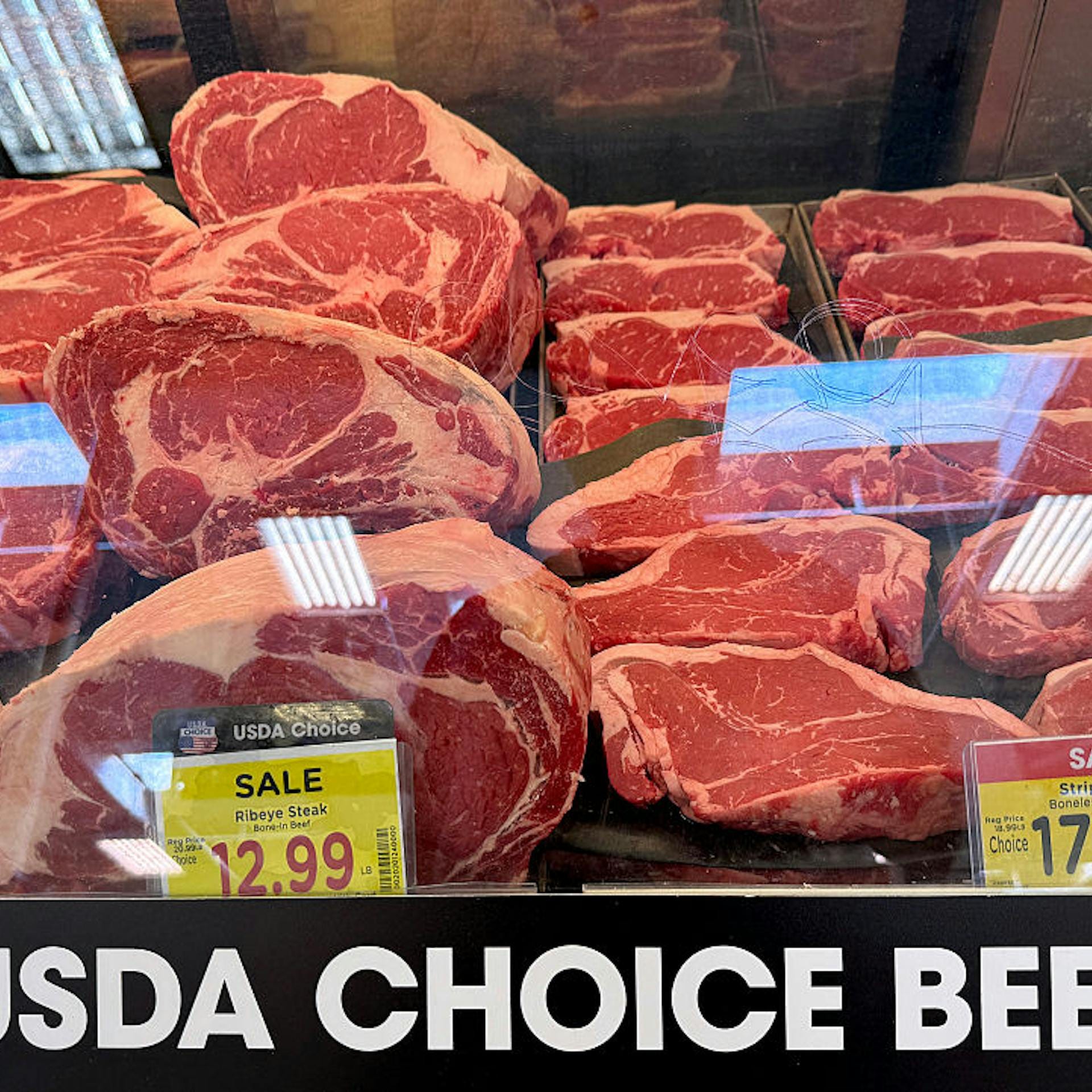
Think of your favorite Ron Swanson quote when you read about why ground beef is so expensive at the grocery store…and realize you don’t hate the USDA and crony capitalism nearly enough…because there are verifiable reasons your grocery bill keeps climbing.
From The Daily Wire:
Consumers are feeling the effects of rising beef prices every time they walk into the grocery store. What many don’t realize is that those prices are the result of pressures that have been building on American farmers for decades.
Today, the U.S. cattle herd is at its lowest level in roughly 75 years. It may sound like a simple supply-and-demand problem, but after more than 50 years in the cattle business, I can tell you it’s more complicated than that.
The cattle shortage we are experiencing today did not happen overnight. Years of rising operating costs, growing competition from imports, and industry consolidation have forced many ranchers to reduce their herd sizes or leave the business altogether. And while there are efforts underway to rebuild the nation’s cattle herd, it will take time. And the rebuild is not a certainty. A cow’s gestation period is nine months — then it takes another two years for that calf to reach slaughter. A herd rebuild is measured in years, not months.
But the cattle shortage itself is only part of the story.
Many consumers have little knowledge of where their beef actually comes from. Current labeling rules can allow imported beef to be processed domestically and marketed in ways that leave consumers with the impression it was entirely produced in the United States. At the same time, the modern American beef supply chain has become increasingly dependent on imported lean beef, which is frequently blended with domestic beef before reaching consumers.
As a result, consumers often have no clear way of knowing where the beef they purchase originated or how much of it was raised by American ranchers. The lack of transparency makes it difficult for consumers to make informed purchasing decisions and intentionally support domestic producers.
At the same time, four major meatpacking companies process the vast majority (about 80%) of America’s beef. This concentration has reduced competition, weakened the bargaining position of American ranchers, and placed significant influence over pricing and supply chains in the hands of a small number of companies.
When consumers see higher beef prices, they should understand that many ranchers are not the ones setting these prices. Most are simply trying to stay in business, while remaining largely at the mercy of a highly concentrated meatpacking industry.
Every word of this tracks with what I grew up around. My family has run cattle since the 1850s. So when a man who’s spent fifty years in the business tells you the beef shortage isn’t simple supply and demand, believe him. But I want to push it further than he did, because the thing that should make you angry isn’t the price of a ribeye. It’s how we ended up in a country where four companies decide what that ribeye costs.
Start with the number the op-ed soft-pedals. Four meatpackers, Cargill, JBS, Tyson, and National Beef, control about 85% of the beef in this country. In 1980 it was 36%. That is not a free market. I believe in free markets, deeply. This is the opposite of one. When four buyers control nearly every slaughter line in America, the rancher doesn’t negotiate a price. He takes the one he’s handed. That’s not capitalism….because new players are excluded from the game via a regulatory stranglehold. A good example is when Facebook was asking the U.S. government to regulate social media…which critics (like myself) took as a way to keep new startups from launching successful social networks.
And before anyone files this under left-wing talking points, don’t. Trump’s own Justice Department opened an antitrust probe into those same four packers in late 2025, looking at price-fixing. When the populist right and the populist left both circle the same four companies, the companies are usually the problem. (Side note, I’m not a populist…so it’s hard to claim I’m biased here).
Then there’s the lie on the label. For years, a cow could be born, raised, and slaughtered in another country and still wear a “Product of USA” sticker, as long as it got repackaged on our side of the border. We used to have a mandatory country-of-origin law. Congress killed it in 2015 after Canada and Mexico complained to the World Trade Organization. So the next time you pick up ground beef with a flag on the package, understand that you may have no real idea what country the animal lived in. A voluntary fix finally took effect this year. But it’s voluntary, and a future administration can wipe it out with a pen. The actual fix, mandatory labeling, sits in a bipartisan bill that the packing lobby has smothered in the crib for a decade. Transparency is the whole game. They’ve spent a fortune making sure you don’t get any.
My great uncle ran a general store in Fishhook, Illinois, before and after the war. While he was overseas fighting Nazis, his wife ran it alone. People brought him eggs, pork, beef, chicken. He gave them Levis, boots, and dry goods in trade. That was a food system. Local, accountable, resilient. You knew the man who raised your hog, because he was standing right there at the counter.
We don’t allow that anymore. Not really. And here’s the part people get wrong, so let me be precise. You can still butcher a steer on your own land and stock your own freezer with it. What you cannot do is sell your neighbor a single steak from that animal unless it first rides a trailer to a USDA-inspected plant. For a lot of small ranchers, the nearest one is hours away, because the small local slaughterhouses are mostly gone…and the ones still around are booked so far out that you have to schedule a butchering appointment before the calf is born (this is not hyperbole…we process some of our own cattle for the family to consume). They’re gone because the inspection rules were written for plants that kill 400 cattle an hour, and no small operator can carry that cost. The regulation that gets sold to you as safety works, in practice, as a moat around the giants.
COVID proved it in the ugliest way possible. When the big plants shut down, farmers euthanized healthy animals they had no legal way to process, while grocery shelves sat empty a few miles away. There was meat. There was demand. The law stood in between them.
There’s a bipartisan bill to loosen this, the PRIME Act. It’s carried by a Democrat from Maine and a libertarian Republican from Kentucky, which should tell you it isn’t a partisan idea. The cattlemen’s lobby opposes it, which should tell you exactly who the current arrangement serves.
And spare me the food-safety sermon. Inspection matters, fine. But centralizing the whole supply didn’t make your food safer. It made the failures bigger. When one plant grinds beef from thousands of animals and ships it to forty states, a single contaminated carcass becomes a national outbreak and a recall measured in tens of millions of pounds. The blending the op-ed mentions is the quiet horror of it: mix lean trim from a dozen sources into one batch, and one bad input poisons all of it. In a local system, a careless operator sickens a town. In this one, he sickens a region, and good luck tracing it back to him.
None of this happened by accident, and none of it happened overnight. It happened one merger, one repealed labeling law, one inspection rule at a time. Each step defensible on its own. All of them together adding up to a nation that can’t feed itself without permission from four corporations and the agencies that guard them.
My family has raised cattle since before the Civil War. I’d like to think that will continue to my children and grandchildren’s generations. Right now, the law is betting they won’t.
[four]
Well, Ethopia gets to fix elections, keep on genocide-ing, and maybe start a war with Egypt…and nobody is much paying attention.
From the Associated Press:
Ethiopia’s ruling party has maintained an overwhelming majority in parliament following the June 1 election, according to final results on Sunday.
Prime Minister Abiy Ahmed’s Prosperity Party won 438 seats out of 501 in the House of Representatives, the National Election Board of Ethiopia said. The new parliament is expected to convene in October to reelect Abiy for another five-year term.
The election was marred by a crackdown on dissent. Insecurity in the Oromia and Amhara regions resulted in 143 polling stations failing to open, the election board said. Fighting between the Fano armed group and the federal government in Amhara, and the Oromo Liberation Army rebels in Oromia, has been the main cause of instability as the government seeks to disarm the groups.
Turnout was 94%. More than 50 million people, out of Ethiopia’s estimated population of 130 million, were registered to vote, the board said.
The Tigray region, where hundreds of thousands of people had died in the war between the federal forces and regional groups, was again excluded from the election, denying it a voice in parliament and further pushing it to the margins. The region has not had federal representation for six years.
Abiy Ahmed’s party just took 438 of 501 seats on 94% turnout, which is about the margin you’d expect in a country where the result was settled before anyone walked into a polling station. It’s his second straight blowout. His party won 94% of parliament in 2021 too, so this is less an election than a renewal of vows.
It’s worth remembering who this is. Abiy won the Nobel Peace Prize in 2019 for making peace with Eritrea, and within three years he was running one of the deadliest wars of the century inside his own borders, in Tigray, with Eritrea by then fighting alongside him instead of against him. Hundreds of thousands died. The man on the medal and the man running this election are getting harder to square.
And look at the fine print on that turnout. Tigray didn’t vote at all, shut out for the sixth year in a row, with no seat in the parliament that governs it. Parts of Amhara and Oromia couldn’t open their polls because the federal government is actively at war with armed groups in both. So the three regions with the most reason to want Abiy gone are the three with the least ability to say so. A clean sweep comes easy when the people most likely to vote against you are the ones who can’t.
If you’re inclined to file this as another Christian-versus-Muslim story out of Africa, don’t bother. Tigray is Christian. Eritrea, which helped flatten it, is Christian. Amhara, now in open revolt, is Christian. Abiy himself was born to a Muslim father, raised partly Orthodox, and worships today as a Pentecostal. Ethiopia’s fractures are ethnic and regional, drawn around land, autonomy, and one man’s appetite for pulling power toward the center. Religion is tangled up in all of it, but it isn’t what’s driving the killing.
The part actually worth watching isn’t the seat count. Abiy has started calling Red Sea access “existential” for a landlocked Ethiopia, and that push has already nudged Eritrea, Somalia, and Egypt into a loose front against him. A leader who just bought himself five more years at home usually goes looking to spend it somewhere. A landlocked country hunting for a coastline is how regional wars get started.
You'd think the "genocide in Palestine" crowd who trash their own college campuses and praise Hamas for raping Jews and holding hostages for years on end would be all over this. Hundreds of thousands dead in Tigray, a region starved and shut out of its own government, and somehow the people who've memorized every checkpoint in the West Bank can't find Ethiopia on a map. Turns out the outrage runs out exactly when the social media trend fades.
If you want to do something here…my family sponsors a child with Compassion International (no, this is not an ad), an org I’ve traveled with in Mexico…they do amazing work. There are kids in Ethiopia that have been waiting 600+ days for regular food, school supplies etc. You can sponsor one here.
[five]
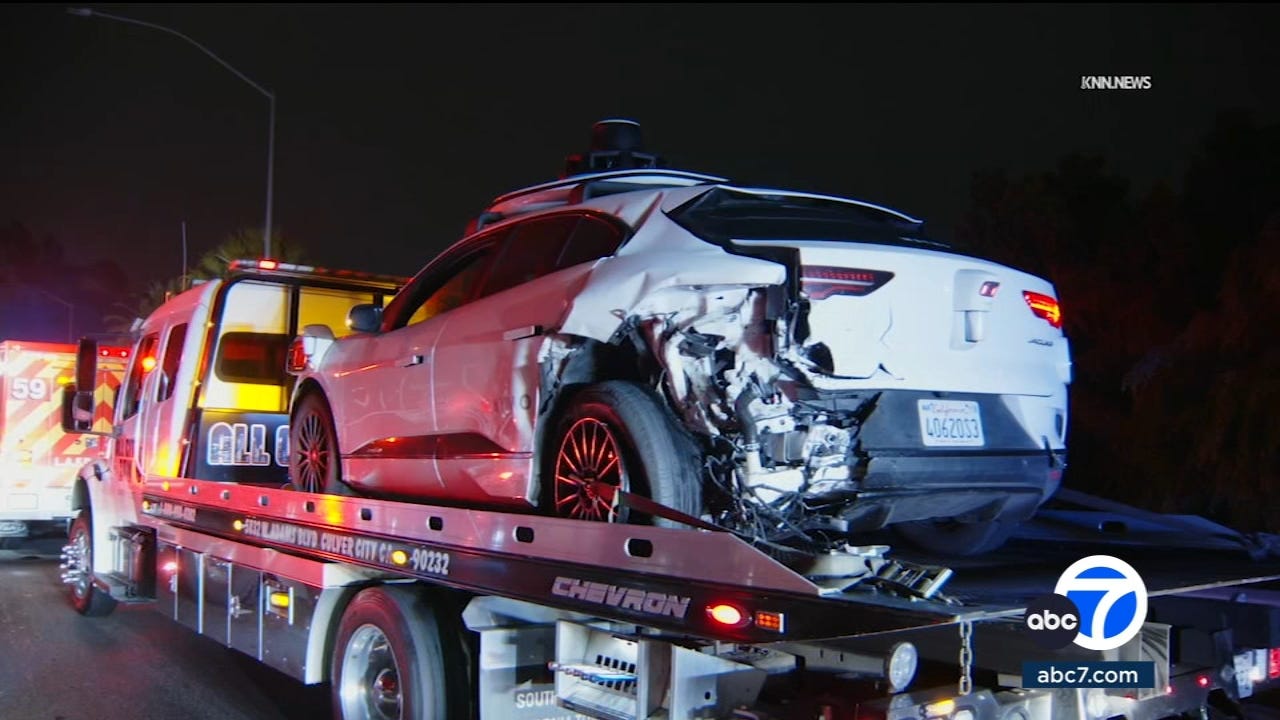
And finally, the self-driving car thing…aint going great this month.
Waymo is recalling nearly 3,900 robotaxis after their self-driving software repeatedly failed to recognize ramp closures and construction zones in incidents in Arizona and California, according to a recall notice posted by the National Highway Traffic Safety Administration.
The recall comes after Waymo reviewed incidents that occurred in April and May in Phoenix and the San Francisco Bay Area. The autonomous driving company temporarily restricted robotaxis from driving on freeways while it investigated the issue.
The recall impacts Waymo’s so-called 5th Generation Automated Driving System (ADS), which powers its fleet of Jaguar vehicles. The NHTSA said all of the recalled vehicles are believed to have the software defect.
“Under certain circumstances, the [autonomous vehicle] may enter and drive at speed in freeway construction zones due to inappropriately prioritizing the avoidance of other freeway hazards and/or failing to recognize the construction zone,” the recall notice states.
Waymo, a subsidiary of Alphabet, expanded freeway driving last year, adding the capability to its vehicles in San Francisco, Phoenix and Los Angeles.
Umm…I’m very pro-technology and pro-AI, but I don’t want to be sharing the road with one of those things.
Until the next one,
-sth